How the Quran Was Revealed and Preserved Over Centuries
The Holy Qur’an is the sacred scripture of Muslims, which they believe cannot be altered or tampered with. It is the divine word and message, and no power can change the words from the Holy Qur’an, as the Almighty has taken the responsibility to preserve it. Also, this book was revealed at once. There is a lengthy process that spanned more than two decades, showing the entire book. This piques everyone’s curiosity about how the Qur’an was revealed and preserved over the centuries.
If you are planning to visit the places of revelation soon during your Umrah, we are here to tell you everything that you need to know. Let’s talk about the stages of the Qur’anic revelation and the history of preservation that will elevate your trip to Makkah and Madinah. It is time that you increase your knowledge about the Qur’anic revelation.
Divine Process of Gradual Revelation
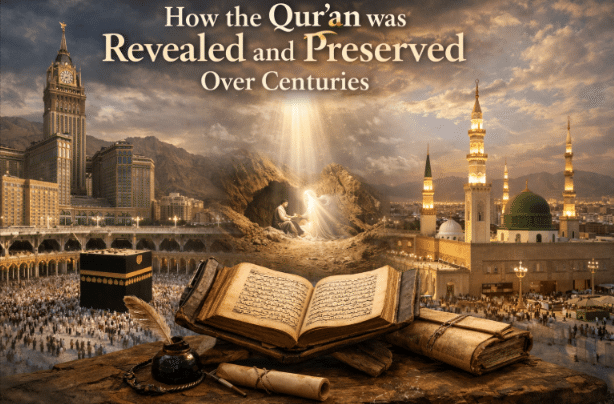
The Holy Qur’an was revealed to our beloved Prophet Muhammad (SAW) over a period of approximately two decades. This process began at the start of 610 CE and concluded shortly before the Prophet’s (SAW) death in 632 CE. During your pilgrimage, you will come across many sites of revelation in the sacred cities.
Pilgrims make sure to visit Cave Hira, located near Makkah. This is where the process of revelation began. Angel Jibrail (AS) visited the Prophet (SAW) when he was meditating in this cave. He recited the first few verses of Surah Al-Alaq. The process ended with a few verses of Surah Al-Baqarah in Madinah.
Qur’anic revelations were used to address various social and societal issues in different contexts. These verses addressed numerous matters, ranging from legal issues and spiritual advice to answers to questions posed by the Prophet Muhammad (SAW), which aimed to teach the religion to his followers.
The original language of this revelation was Arabic, which is the local language of the people of the Prophet (SAW). The delivery style of these verses was also poetic and profound, which attracted the people.
The First Mode of Preservation
The first mode of preserving the Holy Qur’an was memorisation. Arabs were renowned for their exceptional memory, intellect, and recitation skills. They were known to be very eloquent people. Additionally, it was a very oral society; the followers of the Prophet (SAW) quickly began memorising the divine words. The Prophet (SAW) encouraged his companions and followers to memorise the Holy Qur’an from the beginning. This process involved the Prophet (SAW) reciting the verses aloud, and his Huffaz, or memorisers of the Qur’an, would carefully commit the verses to memory.
Although this is how the preservation process began, and now we have numerous facilities and written and digital versions of the Holy Book, millions of Muslims still memorise the Holy Qur’an to date. Therefore, the exact words of the Qur’an, as revealed 1400 years ago, are still preserved and will always be maintained in this manner.
Written Compilation During the Prophet’s (SAW) Lifetime
Initially, the Qur’an was memorised. But this wasn’t the only way of preservation. Scribes like Zayd ibn Thabit also recorded it during the lifetime of the Prophet Muhammad (SAW) (Al-Azami, 2003). The verses were written on parchment, bones, leather, and palm leaves. This preservation took place in fragments and wasn’t compiled into a single book during the Prophet’s (SAW) lifetime, mainly because the revelations continued (Burton, 1977).
The correct placement of each verse in its respective Surah was ensured by the Holy Prophet (SAW), whom the Almighty guided. Therefore, the organised version of the Holy Qur’an that we see and read today is consistent and accurate as the Creator wanted it to be. All memorised and written versions of this sacred book are based on the authentic, organised version.
Compilation Under Caliph Abu Bakr (RA)
During the time of Caliph Abu Bakr (RA), the Holy Quran was compiled into a single manuscript for the first time. After the martyrdom of many Huffaz during the Battle of Yamama, there was a serious concern about the preservation of the Holy Quran (Nasr et al., 2015). Therefore, on the suggestion of Umar ibn Al-Khattab (RA), Abu Bakar (RA) commissioned one of the earliest scribes, Zayd ibn Thabit, to collect and compile the Quran. He took both written and memorised versions to verify the authentic version before compiling it. This master copy was kept with Abu Bakr, then passed to Umar (RA), and eventually to Hafsa (RA), the Prophet’s widow.
Standardisation Under Caliph Uthman (RA)
Islam started spreading rapidly around the region during the time of Caliph Uthman (RA). The Holy Qur’an reached people with different dialects, which created a variation in recitation. Therefore, to preserve the unity of the sacred book, Caliph Uthman (RA) ordered the creation of standardized versions of the Qur’an, based on the manuscript compiled by Abu Bakr (RA) (Al-Azami, 2003).
He then ensured that various copies of this version were distributed throughout the Islamic world to ensure uniformity. All the unofficial copies were then destroyed to ensure that the whole Muslim world has the same version of the Holy Qur’an (Burton, 1977).
Visit Museums in Makkah and Madinah for Quranic History
Do you know some of the best places to get a glimpse of the rich history of Quranic revelation and preservation? These would surely be the two most sacred cities in Islam, which are also the cities of Quranic revelations. These are the cities where Angel Jibrael (AS) brought the divine messages of the Almighty and where Prophet Muhammad (SAW) began spreading these messages.
Pilgrims who visit these two sacred cities for their pilgrimage often try to visit museums, such as the Holy Quran Museum in Makkah, where they have the opportunity to explore the history and preservation of the Quranic revelation.
If you plan to visit these two sacred cities soon, it is time to start applying for the perfect visa. For anyone who wants to perform the pilgrimage, Umrah packages from the USA are also available. However, if you want to explore them as a tourist, you can do so by applying for a tourist visa. No doubt, a trip to the museums in Makkah and Madinah will not only enlighten you about Islamic history but will also give you an incredible faith revival.
Summing Up
Ever since the official copies of the Qur’an were distributed by Caliph Uthman (RA), this version has been memorised and copied over the centuries. It is still preserved word-for-word not only on pages but in the hearts of the Muslims. On your visit to Makkah and Madinah, you will have the opportunity to visit various places where the Holy Qur’an was revealed and reflect upon the divine message. It is truly a surreal and faith-reviving experience that you will not want to miss.
To continue this beautiful connection with the Qur’an, many families today also choose an online Quran teacher for kids to help their children learn proper recitation, understanding, and memorisation from an early age, ensuring the message of the Qur’an lives on in the next generation.
Frequently Asked Questions (FAQ)
1. How was the Qur’an preserved over time?
The Qur’an was preserved through memorization (Hifz) and written records on materials such as parchment, bones, and leaves. Later it was compiled and standardized.
2. Who compiled the Qur’an into one book?
Caliph Abu Bakr (RA) ordered the first compilation under the supervision of Zayd ibn Thabit (RA).
3. Why was the Qur’an standardized?
Caliph Uthman (RA) standardized it to avoid differences in dialect and ensure unity of recitation.
4. Is the Qur’an still the same today?
Yes, Muslims believe the Qur’an remains unchanged and preserved in its original form.
5. Where can I learn Qur’an history?
You can visit Islamic museums in Makkah and Madinah such as the Holy Quran Museum.